
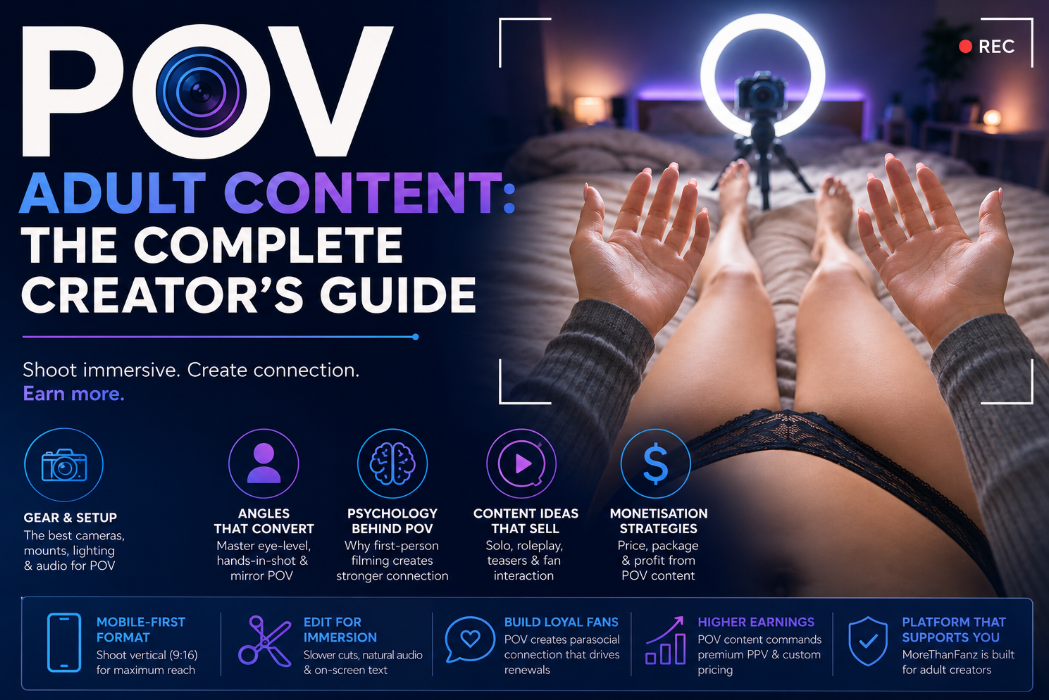
POV Adult Content: The Complete Creator's Guide
First-person filming changes the maths on subscription content. A well-shot POV clip does not feel like watching. It feels like being there, and that single shift in perception is what turns one-off buyers into long-term fans. This guide covers how to shoot POV adult content that converts on MoreThanFanz and other subscription platforms, from gear and angles to the psychology behind why it works and how to price it.
What Is POV Content and Why Does It Outperform?
POV stands for point of view. It means the camera replaces the viewer's eyes, putting them inside the scene rather than across the room from it. The format works in photos, video clips, GIFs, and livestreams. Anywhere a fan consumes your content, you can shoot it in POV.
The reason it outperforms third-person content is simple. Conventional framing tells the viewer that something is happening. POV makes them feel like it is happening to them. Pair that with direct lens engagement, intimate dialogue, or implied eye contact, and you have content that reads as personal even when it is not.
The Psychology Behind Why POV Sells
Mirror neurons are a part of the brain that fire both when we act and when we watch someone else do it. POV amplifies this effect because the visual cues match what the viewer would experience if they were in the scene. The result is a more immediate emotional and physiological response than third-person content typically produces.
Subscription content thrives on parasocial connection. Fans pay for the feeling of knowing you, not just for the content itself. First-person framing is the most direct way to deliver that feeling at scale. Once a fan has had a strong POV experience from a creator, they tend to renew. POV is one of the most reliable formats for building repeat-buyer behaviour.
Gear That Makes POV Content Look Professional
Cameras and Action Cams
You can start with a smartphone. A modern iPhone or Android with a strong front-facing camera will produce content that converts. When you outgrow that, action cameras like the GoPro Hero series, DJI Osmo Action, or Insta360 are built for this kind of filming. Wide-angle lenses, in-body stabilisation, and small form factors make them ideal for hand-held or mounted POV.
Mounts: Chest, Head, and Neck Rigs
Hands-free is where POV moves from passable to genuinely immersive. Chest harnesses sit at roughly belly-button height and give a natural, realistic eyeline. Head straps put the camera where your eyes are, which works for true first-person scenes. Neck mounts are a comfortable middle ground. A flexible-leg tripod (the Joby Gorillapod is the standard) clips to almost anything and costs very little.
Lighting for First-Person Shots
POV lives or dies on lighting. Because the camera moves, harsh light creates jarring shadow shifts that break immersion. Soft, diffused, front-facing light is what you want. A ring light positioned above and behind the lens, or two LED panels on either side at chest height, will cover most setups. Our breakdown of lighting for nude photos covers the technical side in detail.
Audio (the detail most creators miss)
Built-in camera audio almost always sounds thin on close-up POV. A clip-on lavalier microphone is the cheap fix. For higher-end production, a small directional mic positioned just out of frame will pick up breath, voice, and ambient detail without sounding tinny.
Angles and Framing That Convert
Eye-level is the workhorse angle. It puts the camera roughly where your eyes would be standing or lying in the scene, which reads as natural. Over-the-shoulder POV (camera slightly above and behind) adds depth and works well for full-body shots.
Show your own hands and partial body when you can. The brain reads "those are my hands" almost instantly, and the illusion of being in the scene gets stronger. Mirror reflections are a powerful hybrid: the camera shoots POV, but the mirror lets your face and body appear in the same frame.
Mistakes to avoid: filming too close (loses context), unnaturally high angles (looking down at yourself breaks the illusion), and uncontrolled camera shake. Slow, deliberate movement is what reads as cinematic.
Sets, Lighting, and Wardrobe That Read Well in POV
POV is intimate, so your setting should feel that way. A bedroom or domestic backdrop is the safest read. Avoid cluttered backgrounds that pull focus. Soft, uncluttered settings keep attention where it belongs.
Wardrobe matters more in POV than in conventional shots because the camera is close. Textures pop. Silk, satin, lace, and well-cut lingerie all photograph beautifully in first person. Anything that catches light reads best.
POV Content Ideas That Sell
Solo POV: self-touch, mirror moments, slow undressing. Reads as a private moment shared directly with the viewer.
Implied partner POV: direct lens engagement, paced dialogue, scenarios where the lens stands in for a partner.
Roleplay POV: girlfriend experience scenarios, scripted scenes, fantasy setups. First-person framing makes the script land harder.
SFW POV teasers: a slow zoom POV walk through your home, a close-up beauty moment, a getting-ready clip. These translate to social media without breaching platform rules and drive traffic to your paid content.
Editing POV for Maximum Impact
Pacing in POV is different. Cuts that are too fast break immersion. Hold shots longer than you would in conventional editing. The viewer is meant to feel present, not directed. Layer in clean breath or voice audio, and add captions or text overlays for muted-autoplay environments.
Subscription platforms are mobile-first, so shoot or crop to 9:16 vertical. For a deeper polish on colour and finish, our guide on advanced editing techniques covers grading and retouching that apply equally well to video.
How to Monetise POV Content
POV commands premium pricing because it feels custom. Price PPV POV at a noticeable mark-up over your standard feed content. Build series (Episode 1, Episode 2, and so on) so fans have a reason to come back. Custom POV requests are some of the highest-value content you can sell. Scope clearly, agree on length and act in advance, and price for the time involved.
To consistently monetise POV content, you need a platform that respects adult creators and pays fairly. Sign up as a creator on MoreThanFanz to start publishing.
Frequently Asked Questions About POV Content
Do I need a professional camera to start filming POV content?
No. A modern smartphone with a strong front-facing camera and decent lighting will produce POV content that converts. Once you have proven the format works for your audience, upgrading to an action camera or mirrorless setup is a sensible next step. Plenty of top earners still shoot on phones.
What's the difference between POV and first-person shots?
The terms are functionally interchangeable in adult content. "First-person" is the broader cinematographic term, while "POV" usually implies the camera is deliberately positioned to feel like the viewer's eyes. In practical creator usage, they mean the same thing.
How long should a POV video be to convert paying fans?
For PPV content, 60 seconds to 5 minutes tends to perform best, with longer cuts (10 minutes or more) reserved for premium pricing or custom orders. Your own analytics will tell you the truth. Look at drop-off points, and you will know exactly how long is too long for your specific audience.
Can I create POV content as a solo creator without a partner?
Yes, and many top earners do exactly that. Solo POV using mirrors, implied-partner framing, and direct lens engagement produces some of the highest-converting content on subscription platforms. You do not need a partner to make first-person content feel intimate.
Is POV content allowed on all subscription platforms?
Most adult content platforms allow POV, though each has its own rules about filming, consent documentation, and platform-specific moderation. MoreThanFanz is built specifically for adult creators, so POV is fully welcome. Always check the platform guidelines before publishing.
Can I film POV without ever showing my face?
Yes. True first-person filming naturally keeps your face out of frame, since the camera replaces your eyes. For mirror shots, crop above the chin or use careful framing. Pair this with the approach in our personal branding guide, and you can build a strong, recognisable brand without revealing your identity.